About Knights and Merchants
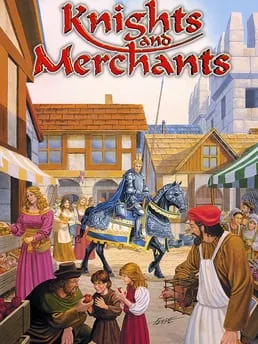
Knights and Merchants: The Shattered Kingdom is a medieval real-time strategy game developed by Joymania Entertainment. TopWare Interactive published it in Germany on September 18, 1998, and in Europe that November, and Interactive Magic released it in North America in October 1998. Peter Ohlmann, André Quass and Adam Sprys designed it, and Larry Elmore painted the cover art. Its world is invented, but everything in it is modelled on Europe, especially the Anglo-Saxon period, around 1200 AD. You play the captain of the palace guard, leading its soldiers and citizens to victory.
The game is known for its economy, which is more involved than in most strategy games. Basic resources have to be combined to make anything useful: for bread you need a farm for wheat, a mill for flour and a bakery to bake it, and every building has to be connected by roads. Everyone eats, from workers and farmers to soldiers, and a unit that goes unfed long enough dies. There’s no unit cap; the size of your army is limited by how much food you can produce. You start with only a school house that trains workers, and more buildings open up as you build.
The campaign has 20 missions, which can take anywhere from about five minutes to seven hours or more, and the original also had multiplayer for up to six players over a local network, TCP/IP or modem. The stand-alone expansion The Peasants Rebellion followed in 2001, and versions for Linux, Mac OS and MorphOS came later. Reviews were mixed; Next Generation wrote that it “may not break much new ground, but it follows footprints with style.” TopWare Interactive still publishes the game today.
How it runs in your browser
When you press Play, the game’s page on dos.zone opens in a new tab. DOS.Zone runs the original Windows version inside js-dos, its open-source take on DOSBox for the browser, which starts an emulated Windows 95 PC with the game installed. The disk loads in pieces as it’s needed, so the first start takes a minute or so. You don’t install anything or bring your own files, there’s no account, and DOS.Zone shows no ads.
On 11 November 2026, in desktop Chrome, it booted to the English main menu, marked version 1.3, with options including Load saved game, Start Multiplayer game, View credits and Quit program. The listing has a rating of 5 from 23 player reviews, and its page also offers a switch to a Russian version; the default is English. DOS.Zone’s toolbar has a save button for the emulator state, but it doesn’t say how long saves are kept, so use the game’s own saves as well.
Controls and devices
Knights and Merchants is played with the mouse: placing buildings and roads, choosing what workshops make and sending troops into battle. Click inside the game window once it loads so the emulator captures the mouse; Esc releases it, and a slider on the left sets the mouse speed. DOS.Zone offers on-screen controls for phones, but a building game this detailed needs a precise pointer, so use a computer. We haven’t checked Chromebooks.
Tips
- Build up food early. Every worker and soldier eats, and hunger is what really limits your army.
- Plan roads before you place buildings, since everything has to be connected.
- Follow each chain through: a farm alone isn’t enough without the mill and bakery that turn wheat into bread.
For more settlement building from the same years, The Settlers II and Anno 1602 are also on DOS.Zone, and Age of Empires mixes economy and war in the same way.
Is Knights and Merchants: The Shattered Kingdom Free, Safe and Official?
Can I play Knights and Merchants online for free?
Yes. DOS.Zone runs the original Windows version free in a browser tab, with no download and no account. It isn’t made or endorsed by TopWare Interactive, which publishes the game.
Is this version in English?
Yes. On 11 November 2026 it booted to the English main menu, marked version 1.3. DOS.Zone’s page also has a button to switch to a Russian version, so stay on the default if you want English.
Can I play Knights and Merchants multiplayer in the browser?
The menu still has a multiplayer option, which originally worked over a local network, TCP/IP or modem for up to six players. DOS.Zone doesn’t list a multiplayer room for it, so plan on the single-player campaign.